Extreme Wordsearch
The five-letter wordsearch
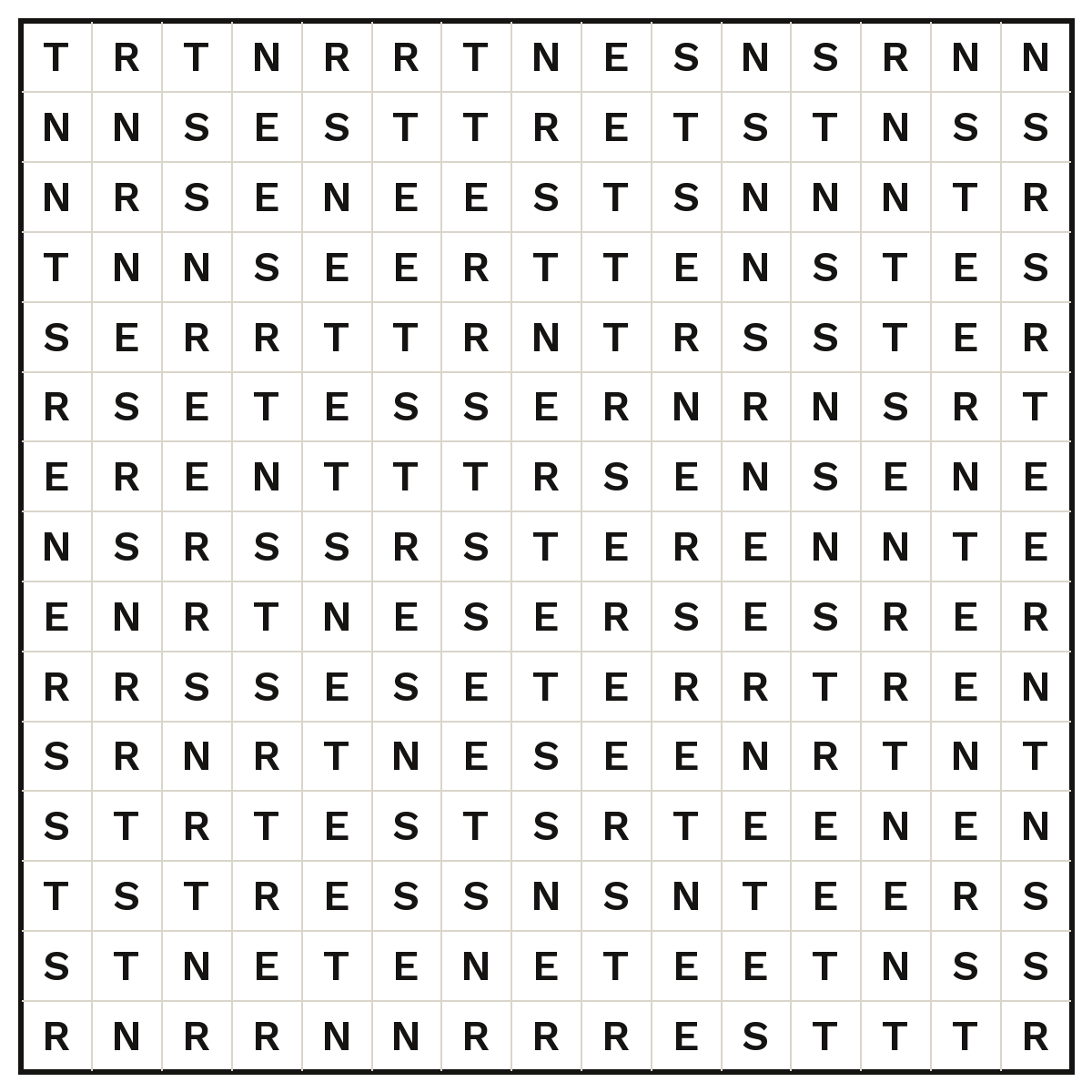
An ordinary wordsearch hides its words in a sea of random letters. Ours hides them in a sea of the same letters: every grid is built from just five, and so is every word in it. The word you are looking for is surrounded by near-copies of itself.
Why five letters makes it hard
In a normal wordsearch your eye does most of the work. A Q, a Z or a double letter jumps out of the page, and once you have one letter the rest of the word is a short scan in eight directions. With five letters there is nothing to jump out. Looking for RESENT in a grid of E, N, R, S and T, you meet RESEN, RENEST, ERSENT and a hundred other near-misses before you find the real one. Every word must be checked letter by letter, and every false start costs you.
It is still a fair puzzle. Each word appears exactly once, in a straight line, forwards or backwards, in any of the eight directions. Nothing is hidden in a way a normal wordsearch would not allow. The grid simply refuses to give anything away.
How to solve one
- Start with the rarest letter in the word, not the first. In a grid of E, N, R, S and T, the least common letter on the page is your best anchor.
- Look for the rarest pair. Two adjacent letters that are unusual together (such as NR or TN) cut the candidates far more than a single letter does.
- Check backwards as often as forwards. Half the words run right to left or bottom to top; your eye prefers the other half.
- Cross off as you go. Found words are the only landmarks the grid has. Mark them and the remaining space shrinks fast.
- Do the long words first. A long word has more letters to match, so false starts die sooner. The short words at the end of the list are the real test.
The books
Extreme Wordsearch 1 has 150 of these grids, one per page, 16 × 16, each built from five letters, each with its own word list. Full solutions are at the back. Two editions: British English (colour, centre, favourite) and US English (color, center, favorite). Extreme Wordsearch 2 follows with 150 new grids, none repeated from book 1, and no word shorter than five letters (out 17 November 2026, both editions).


Those buttons open the British English edition; the US edition is on its own page.
Try one first
The grid above is a free 15 × 15 sample that is in none of the books. Download the PDF, print it on A4 or US Letter, and time yourself. Most people take far longer than they expect. More free puzzles and gift ideas are on the gifts page.
If you prefer logic to letters: our sudoku and killer sudoku books come with a step-by-step solution for every puzzle.